
Statutory Information
At Anstey First School, we want pupils to develop the key skills and knowledge they need to progress to their next stage of education. To do this, we have refined and adapted our curriculum over years to ensure that our pupils are getting the absolute best learning opportunities and can make the progress they need. Our curriculum is tailored to meet the needs of each pupil, and we work hard to remove barriers to learning to enable progress. The core principle of our curriculum is that ‘learning is a long-term change in memory’.
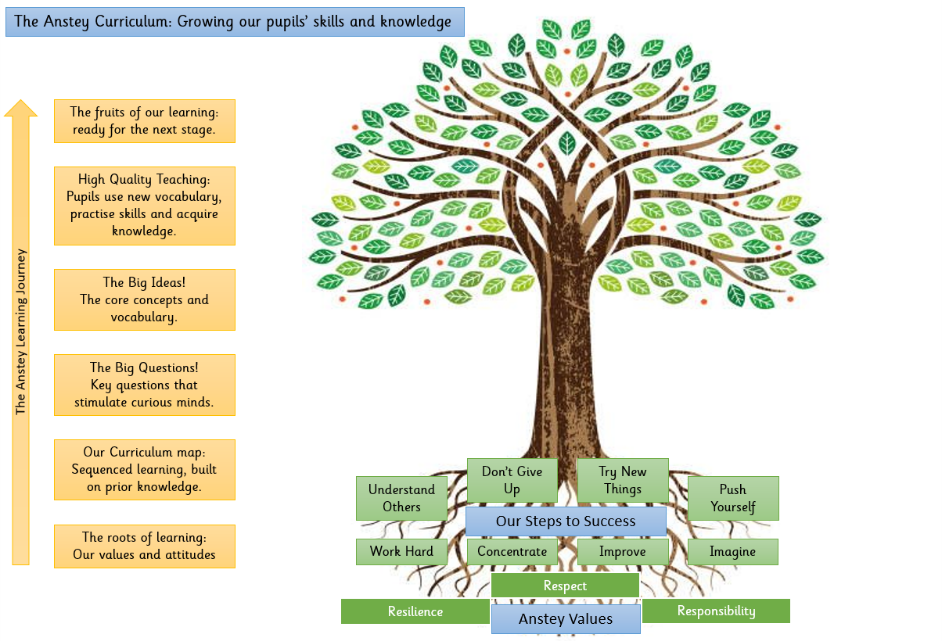
Selection and design
We use an adapted version of the Essentials Curriculum, which was developed by Chris Quigley. This is a widely used model for curriculum delivery and is underpinned by extensive scientific and education research. Our curriculum is set up so that learning and progress happen over time and allows for multiple opportunities to repeat content and develop understanding of key concepts.
Anstey’s approaches, values and curriculum are integrated. This means that the way we teach our pupils is designed to develop their resilience and independence as learners, encourage them to take responsibility for their learning and respect the importance of the act of learning. We take inspiration from Maria Montessori as well as the best education research: evidence informs our practice.
We aim to grow our pupils’ knowledge and skills by instilling a love of learning, feeding their curious minds with stimulating questions, and providing them with the time and opportunity to practise their newly acquired skills within well-sequenced, highly engaging lessons.
The roots of learning
Our values are at the heart of our school. We talk about them daily and pupils are encouraged to celebrate these values in others. From your first day, we build a sense of belonging, togetherness and mutual support through our establishment activities that take place at the beginning of each term. We show our pupils that they are safe and valued, giving them the nurturing environment they need to start their journey with confidence.
Our Steps to Success come next. These are the eight key skills that all our pupils will develop over their time at Anstey. They promote hard work and creativity as well as compassion for others.
Big Questions and Big Ideas
Our curriculum is sequenced so that pupils return to previously taught concepts throughout their time at school. We carefully consider prior learning and build using small steps to ensure that new information is retained.
Units of work begin with a Big Question. Teachers work hard to develop questions that are stimulating and engaging. We strive to nurture curious minds and introducing new learning through questions works. Straight away, pupils begin thinking of the information they need to answer these Big Questions. Teachers act as guides and facilitators, introducing key Big Ideas to children in carefully planned and sequenced lessons. In this way, we cover the most important concepts and knowledge that are required, while building in multiple opportunities for practising new skills and vocabulary.
Assessment for learning
We act quickly and decisively based on the assessment information we gather. Almost all our assessment of pupils happens in-the-moment, at the point of learning so that we can support and challenge individual learners. Our teaching team spend time refining our approaches and making sure that we are giving each child what they need next.
Progress for every child
We work hard to ensure that all pupils access our curriculum, and that all pupils are challenged and supported in the best way to enable them to progress to their next stage.
Your child’s Journey through Anstey First School
The Early Years
Whether children join us in pre-school, nursery or reception, their journey begins with a warm and nurturing welcome. We work with families to ensure that children have a ‘soft landing’ when they arrive at school. The transition into school can be an upheaval and we recognise our role in making sure that all pupils and families are supported to have the best start they can.
In our Early Years and Foundation Stage (EYFS), learning is largely child-led. We aim to follow the interests of children we work with and listen carefully to them when we plan our themes and activities. Learning is structured thematically so that children learn to make links and connections between their experiences. Our school values and steps to success are incorporated into every day.
By the end of the EYFS, pupils will have completed the Early Years and Foundation Stage Framework and will have acquired the knowledge and skills they need to progress to the National Curriculum, which begins in Year 1.
The EYFS framework consists of seven Early Learning Goals:
- Communication and language
- Physical development
- Personal, social and emotional development
- Literacy
- Mathematics
- Understanding the world
- Expressive arts and design
Building on the fundamentals: Key Stage One
When children transition into Year 1, learning shifts to a context- and subject-specific framework. Our curriculum has been designed to highlight the ‘essential characteristics’ of the different subjects, giving pupils the inspiration and key skills in subject-specific disciplines. Rather than learn about subjects, pupils learn to be experts in that subject i.e., learn to be historians, scientists, artists and musicians as opposed to learning about these subjects.
Key stage one is about developing fundamental skills – those skills that pupils will later rely on for deeper understanding. Although the curriculum is broad and content-rich, learning is very tightly focused on the early basics, building on the knowledge and understanding gained in EYFS. Reading fluency is prioritised, as well as fluency with number. Children are taught to write through immersion in exciting and carefully chosen texts. The core knowledge in each subject is broken down into ‘Essential Characteristics’ and ‘Big Ideas’ - the building blocks of the subject that recur throughout the learning journey.